
RingClusterMotor Class Usage#
Here we explore different features of the RingClusterMotor class.
RingClusterMotor models a ring (annular) configuration of N identical
motors arranged symmetrically around a circular perimeter of a given radius,
with no central motor along the rocket’s longitudinal axis. It is a thin
wrapper around a single, already-defined motor: all thrust-, mass- and
inertia-related quantities are derived automatically from that base motor,
its number of copies and their radius from the rocket’s central axis.
Key Assumptions#
numbermust be an integer>= 2;radiusmust be non-negative;The base motor is currently expected to be a
SolidMotor, sinceRingClusterMotorreuses its grain properties directly;Motors are assumed identical and evenly spaced around the ring (
360 / numberdegrees apart);The transverse inertia (
I11/I22) contribution of each motor is computed explicitly via the parallel axis (Steiner) theorem for every angular position, which keeps the result accurate even for the asymmetricnumber=2case.
Creating a Ring Cluster Motor#
To define a RingClusterMotor, we first need a fully defined base motor
(typically a SolidMotor), then wrap it with the number of motors in the
cluster and their radial distance from the rocket’s central axis:
from rocketpy import SolidMotor, RingClusterMotor

base_motor = SolidMotor(
    thrust_source="../data/motors/cesaroni/Cesaroni_M1670.eng",
    dry_mass=1.815,
    dry_inertia=(0.125, 0.125, 0.002),
    nozzle_radius=33 / 1000,
    grain_number=5,
    grain_density=1815,
    grain_outer_radius=33 / 1000,
    grain_initial_inner_radius=15 / 1000,
    grain_initial_height=120 / 1000,
    grain_separation=5 / 1000,
    grains_center_of_mass_position=0.397,
    center_of_dry_mass_position=0.317,
    nozzle_position=0,
    burn_time=3.9,
    throat_radius=11 / 1000,
    coordinate_system_orientation="nozzle_to_combustion_chamber",
)

cluster_motor = RingClusterMotor(
    motor=base_motor,
    number=4,
    radius=0.1,
)

# Print the cluster (and underlying single-motor) information
cluster_motor.info()
Cluster Configuration:
 - Motors: 4 x SolidMotor
 - Radial Distance: 0.1 m
Nozzle Details
Nozzle Radius: 0.033 m
Nozzle Throat Radius: 0.011 m

Grain Details
Number of Grains: 5
Grain Spacing: 0.005 m
Grain Density: 1815 kg/m3
Grain Outer Radius: 0.033 m
Grain Inner Radius: 0.015 m
Grain Height: 0.12 m
Grain Volume: 0.000 m3
Grain Mass: 0.591 kg

Motor Details
Total Burning Time: 3.9 s
Total Propellant Mass: 2.956 kg
Structural Mass Ratio: 0.380
Average Propellant Exhaust Velocity: 2038.745 m/s
Average Thrust: 1545.218 N
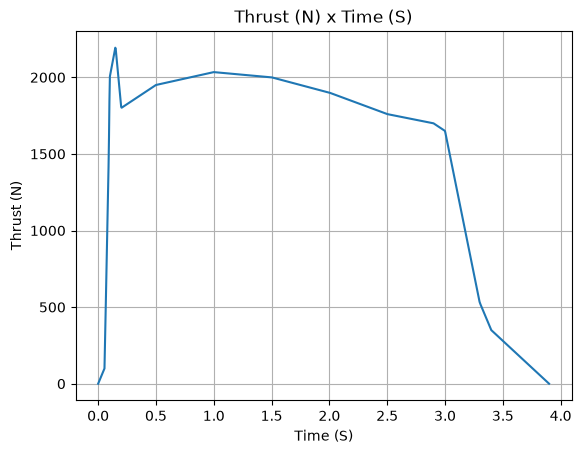
Maximum Thrust: 2200.0 N at 0.15 s after ignition.
Total Impulse: 6026.350 Ns
Note
RingClusterMotor does not read a thrust curve file directly. Instead,
it scales the thrust, dry_mass, propellant_mass and inertia
properties of the motor passed in by number, so any changes to
base_motor must be made before it is wrapped.
Since a RingClusterMotor is a Motor like any other, it can be attached
to a Rocket with Rocket.add_motor() exactly like a SolidMotor,
HybridMotor or LiquidMotor would be.
Visualizing the Cluster Layout#
The draw_cluster_layout method plots the position of each motor around
the ring, which is useful to double-check the number and radius
parameters before running a simulation:
cluster_motor.draw_cluster_layout(rocket_radius=0.15)
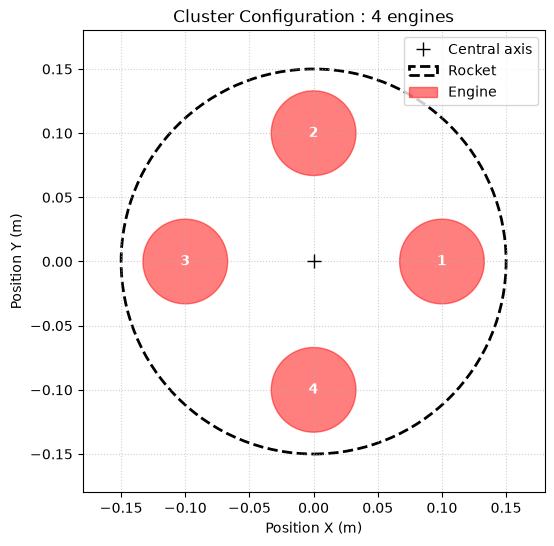
(<Figure size 600x600 with 1 Axes>,
 <Axes: title={'center': 'Cluster Configuration : 4 engines'}, xlabel='Position X (m)', ylabel='Position Y (m)'>)
Tip
Passing rocket_radius draws the rocket’s outer tube as a dashed
circle, which helps confirm that the motors fit inside the airframe.